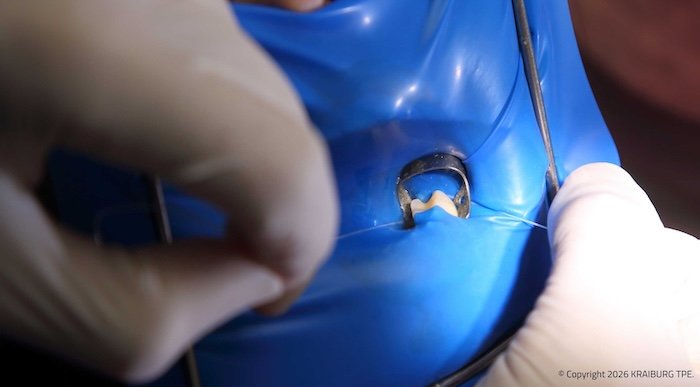
Oral health’s link to overall health and well-being cannot be undermined, making regular dental checkups and thorough examination of the oral cavity increasingly necessary. While innovation in this field has accelerated multifold in recent years, traditional dental film remains a staple in diagnostic dentistry. Dental experts rely on dental film to detect hidden cavities, assess bone loss, and identify deep-rooted dental issues.

Dental films are flexible, moisture-resistant packets used in dental imaging. Thermoplastic elastomers (TPEs) can be used in dental film components, such as the outer packet, because they provide a comfortable and biocompatible casing that protects the imaging components from moisture while remaining durable.
Kraiburg TPE, a global manufacturer of thermoplastic elastomers and customized material solutions, offers medical-grade TPE compounds suitable for a wide range of medical devices and dental components, with soft-touch properties, flexible mechanical performance, and processing versatility.
Kraiburg TPE’s specialized compounds offer elastic properties and soft-touch characteristics to meet the requirements of ergonomic product design, dimensional stability, and reliable performance for optimal comfort for both patients and healthcare professionals. The TPE compounds provide design flexibility, making them ideal for dental components such as flexible connections, seals, mouthpieces, protective elements, and functional features in dental film systems.
Kraiburg TPE’s selected TPE compounds offer reliable adhesion to polyolefins such as polypropylene (PP) and polyethylene (PE), as well as to technical thermoplastics and polyamides, using conventional processes such as injection molding and extrusion, enabling efficient production workflows and design versatility.
Kraiburg TPE’s high-performance TPE materials are designed to be safe, hygienic, and biocompatible. They are sterilizable and free from animal-derived ingredients, latex, PVC, and heavy metals. Selected medical-grade materials comply with key safety standards, including DIN ISO 10993-4 (hemolysis, indirect blood contact), DIN ISO 10993-5 (cytotoxicity), DIN ISO 10993-10 (intracutaneous irritation), DIN ISO 10993-11 (acute systemic toxicity), USP Class VI, and extraction testing requirements.