Medica has its roots in diagnostics. It began in 1969 as ‘Diagnostics Week’. Laboratory medicine remains an integral part of its thematic DNA. As a cross-disciplinary Medical field, it provides a vital basis for decision-making across numerous specialties and plays a central role in prevention, diagnosis, choice of treatment and monitoring of patient progress.

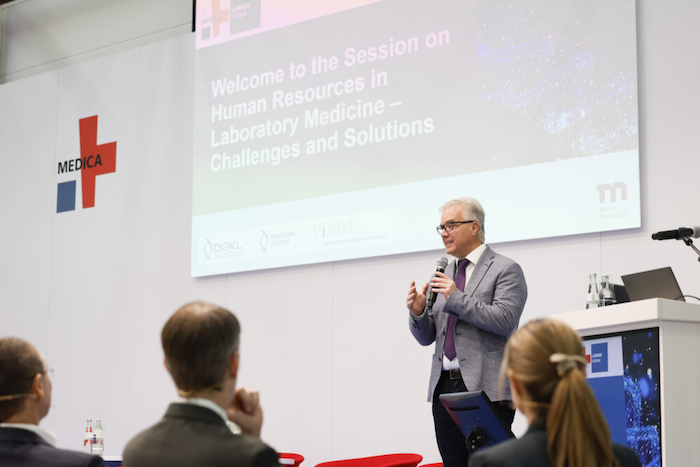
It is precisely this significance and the dynamic development of the field that the Medica Labmed Forum will address as part of Medica 2026, taking place from 16 to 19 November at the heart of the exhibition (in Hall 1). Led by Prof. Dr Stefan Holdenrieder from the German Heart Centre Munich at the Technical University of Munich, the forum combines the latest scientific developments with practical issues in healthcare provision – ranging from the shortage of skilled staff, through robotics and artificial intelligence, to precision diagnostics and health resilience.

The forum thus exemplifies Medica’s transformation process: what matters is not the technology alone, but how it is integrated into existing healthcare structures, supports Medical staff, improves decision-making and ultimately benefits patients.
“Laboratory medicine illustrates what we aim to achieve with the new Medica: we bring together scientific findings, technological innovations and practical application. It is not just a question of what is technologically possible. We want to show how innovation can be integrated into care processes, support healthcare staff and, ultimately, create tangible added value for patients,” says Carmen Berger, the Messe Düsseldorf representative responsible for Medica and the parallel supplier platform Compamed.
Prof. Dr Stefan Holdenrieder describes the transformation of laboratory medicine from a specialist perspective: “Laboratory medicine is at a turning point: moving away from the centralised large-scale laboratory, which operates largely behind the scenes with little patient contact, towards a networked, increasingly decentralized and AI-supported diagnostic system that supports both healthy and sick people much more directly than has ever been the case. The Medica Labmed Forum 2026 demonstrates how this transformation is already taking shape today in research and practice.”
Short presentations, panel discussions and case studies forge a close link between science, industry and practical application. Two sessions are scheduled for each of the four days of the exhibition. Topics range from securing the skilled workforce and specimen logistics, through Laboratory 4.0, robotics and artificial intelligence, to precision diagnostics, new career paths and resilient healthcare systems.
Skills shortage: technology to ease the burden on staff
To kick things off on 16 November, Prof. Dr Thomas Streichert from the University of Cologne will focus on strategies to tackle the shortage of skills. Approaches ranging from recruiting young talent to the automation of manual processes will be discussed. The focus will be on how technology can specifically ease the burden on specialist staff and free up resources for demanding Medical tasks.
In the afternoon, under the title ‘The Sky Is the Limit’, the focus will be on new methods of specimen transport. With increasing centralization, specimens must be transported over greater distances. In future, drones and autonomous robots could help to make logistics processes more efficient and reliable, thereby also ensuring the quality of diagnostic procedures.
Robotics, AI and the Laboratory 4.0
The second day of the exhibition is dedicated to the laboratory of the future. Prof. Dr Stefan Holdenrieder will discuss robotics and artificial intelligence in the context of everyday laboratory work. Particularly during night and weekend shifts, automated systems could, in the future, take over routine tasks and relieve the burden on specialist staff.
Artificial intelligence can also support laboratory workflows, evaluate complex sets of findings more quickly and base Medical decisions on a broader data set. At the same time, new developments in genomics and epigenomics demonstrate how diagnostics are evolving towards earlier and more precise detection of diseases.
Professor Martin Widschwendter from the University of Innsbruck will report on an early cancer detection program based on epigenetic changes in cell-free DNA in blood plasma, its implementation in the UK, and the planned expansion to Australia.
The afternoon session, ‘Make Data Relevant’, focuses on Laboratory 4.0. The discussion centres on how decentralized diagnostics, lab-on-a-chip systems, standardized laboratory values and AI might interact in the future – and how diagnostic information can become available more quickly where it is needed for Medical decisions.
Keynote speaker Prof. Dr Georg Hoffmann sums up this development: “In one or two decades, the laboratory as we know it today will be almost unrecognizable. Centralized laboratory processes, complex sample transport and waiting times of several days for results will, in many places, be replaced by decentralized, AI-supported systems that bring diagnostics to where they are needed – to the patient’s bedside, to the doctor’s surgery, and in many cases even to the patient’s home. Anyone investing in Lab 4.0 today is already shaping the medicine of the day after tomorrow.”
Precision diagnostics: Better data for more personalized treatment decisions
On 18 November, the focus will be on precision diagnostics. Prof. Dr Verena Haselmann from the UKE in Hamburg will shed light on new biomarker technologies and their journey from research to treatment decisions.
A key focus will be on so-called liquid biopsies. These involve detecting molecular changes via cell-free tumor DNA in blood plasma. Such methods can help to identify changes in the course of the disease at an earlier stage and to tailor cancer treatments more precisely to the individual circumstances of patients.
In the afternoon, the forum will focus more strongly on the next generation of Medical professionals. Under the title ‘Careers in Laboratory Medicine: Skills – Flexibility – Future’, career paths in clinical practice, research, quality assurance, self-employment and the diagnostics industry will be presented. In doing so, the forum also addresses the question of how laboratory medicine can attract and retain sufficient numbers of qualified specialists in the long term.
Health Resilience: Diagnostics strengthens people and healthcare systems
On the final day of the exhibition, the Medica Labmed Forum deliberately broadens its focus beyond individual diagnoses. Dr Kai Prager from VDGH Berlin and DiaSys GmbH, together with Brigitte Pfeiff from PFEIFF Science + Healthcare Communications, will explore the topic of health resilience from two perspectives: How can precision medicine and diagnostics help to maintain health for as long as possible? And how must healthcare systems be structured to ensure they remain effective even under changing or challenging conditions?
In doing so, the forum links individual resilience with systemic resilience. Modern diagnostics can detect diseases at an earlier stage and enable more precise treatment decisions. At the same time, automation, decentralized diagnostics, digital connectivity and more efficient processes can help make healthcare systems more resilient in the face of staff shortages, crises or other pressures.
Prof. Dr Johnny Kim, spokesperson for the Cluster4Future curATime innovation network, uses the example of mRNA-based regenerative therapies for cardiovascular diseases to illustrate how research findings ultimately lead to treatments for patients through industrial developments.
The concluding session takes a critical look at precisely this sequence of events: What hurdles are still preventing new technologies from being integrated into everyday healthcare practice? What conditions are required for their implementation? And what examples already demonstrate today that innovation can be successfully translated into healthcare practice? These are the questions that will be explored in greater detail.
This brings us full circle to the strategic development of Medica: from scientific discovery, through technological innovation and integration, to tangible benefits for people and healthcare systems.
The Medica Labmed Forum is accessible with a standard Medica ticket.