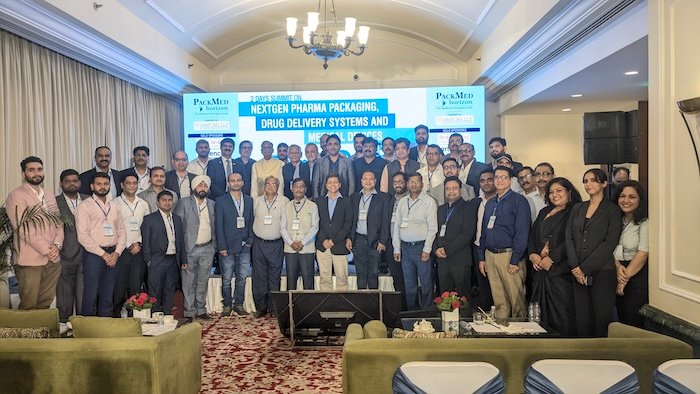
Day 1 of the two-day NextGen Pharma Packaging, Drug Delivery System and Medical Devices Summit, held on 1 September at Eros Hotel, Delhi, brought together pharmaceutical packaging, drug delivery, procurement, quality, regulatory and technology professionals to examine how the sector is evolving.

Discussions 1 highlighted a clear shift: pharmaceutical packaging is no longer simply a container for medicines, but an increasingly sophisticated interface connecting product protection, traceability, patient convenience, regulatory compliance and sustainability.
The day opened with a fireside conversation featuring Sheetal Arora, CEO and director, Mankind Pharma, who reflected on the company’s journey and the importance of staying close to the market.
Speaking about the resilience required in business, Arora said, “Good days will come, very good days will come. Bad days will come. The worst days will come. But those days should not define you. Every day, you get up and go.” He linked Mankind’s growth to affordability, explaining the company entered rural markets with high-quality medicines at lower prices.
The conversation turned to the challenge of maintaining agility as a pharmaceutical organization grows. Arora identified three priorities—investing in systems, empowering employees and staying connected with the field. He noted that Mankind had invested around ₹150 crore in AI during the previous year, while emphasizing that technology must ultimately improve organisational efficiency and innovation.
Counterfeiting emerged as another major concern. Arora called for greater collaboration across the pharmaceutical industry, including a common platform and stronger public awareness around authentication technologies such as QR codes and holograms. He advocated dedicated task forces involving industry and enforcement agencies to strengthen the fight against counterfeit medicines.
The technical sessions moved deeper into next-generation packaging technologies. Soumyanath Mishra, AVP and head of packaging development, Mankind Research Center, discussed emerging drug-delivery and packaging formats, including single-dose systems and dual-chamber technologies.
Single-dose packaging, he explained, can provide preservative-free and sterile delivery while reducing the possibility of contamination. Dual-chamber systems, meanwhile, keep two components separate until activation, allowing them to be mixed immediately before use.
KN Ramaprasad, director sales India, Optel Group, focused on building traceability directly into packaging lines. He argued that traceability should not come at the expense of production efficiency. “When we say traceability, traceability should not again bring down your efficiency. So, we should keep the output constant.” His presentation covered line-level vision and printing systems, serialization, aggregation, software connectivity and supply-chain visibility.
The discussion demonstrated how automation is becoming integral to pharmaceutical packaging. Ramaprasad highlighted the industry’s demand for reduced human intervention, integrated controls and faster root-cause identification. Optel’s approach combines packaging-line automation with traceability so that printing, verification, aggregation and tamper-evident processes can be managed more efficiently.
Another session examined developments in base paper and label stock. Sidharth Jain, managing director, MLJ Industries, emphasized the increasing importance of the substrate, adhesives and release liners in pharmaceutical labels. He highlighted developments, including recyclable release liners, tamper-evident and destructible labels, RFID-enabled tracking and materials designed for demanding temperature conditions. He stressed that patient safety, printability, sterilisation requirements and brand protection all need to be considered while developing pharmaceutical labels.
Drug delivery took centre stage in the session by Santosh Das, director of commercial development for Greater Asia, BD BioPharma. He identified several trends shaping the injectable market, including the growth of GLP-1 therapies, long-acting biologics, the shift from hospital to home care, conversion from intravenous to subcutaneous delivery, larger-volume subcutaneous injections and increasing drug viscosity. The growth of these therapies is driving demand for devices such as auto-injectors, disposable pens and wearable/on-body injectors.
Das underlined the complexity of combination products, where formulation, packaging, device development, regulatory, quality and clinical functions must work together. For generic and biosimilar products, early planning, appropriate device selection and adherence to design and validation requirements can help de-risk development, he said.
Sustainability formed another strong theme. Alvaro Diex Rubio of Constantia Flexibles, alongside Sanjiv Jaggi, argued that sustainable pharma packaging cannot compromise its primary function of protecting medicines. Rubio advocated a lifecycle-based approach covering raw materials, manufacturing, conversion, transport, use and end-of-life. He highlighted lower-carbon aluminium, recycled materials and recyclable packaging structures as potential routes to reduce environmental impact.
Regulatory complexity was addressed by Sriman Banerjee, executive director and head of packaging, Takeda Pharmaceutical Company, who explained the distinction between laws, regulations and standards and their implications for pharmaceutical packaging. His presentation highlighted the growing importance of packaging compliance across the US and Europe, including requirements around child resistance, container-closure integrity, recyclability and labelling.
The day’s final discussions brought together technology and security. Shantanu Chowdhury, CEO, Core Group of Industries, identified anti-counterfeiting, SKU proliferation, expanding regulations, and cost and sustainability pressures as four major forces shaping pharmaceutical packaging. He argued that modern packaging security must move beyond simple identification towards authentication, highlighting technologies involving specialised inks, dynamic codes, visual authentication and forensic identification.
As Day 1 concluded, the entire summit highlighted that the future of pharmaceutical packaging will be defined by the convergence of smart technology, traceability, sustainable materials, advanced drug-delivery systems, regulatory readiness and stronger security. With these themes setting the tone, the industry will look forward to the second day of the summit for further discussions on the technologies and strategies shaping the next generation of pharmaceutical packaging and healthcare delivery.