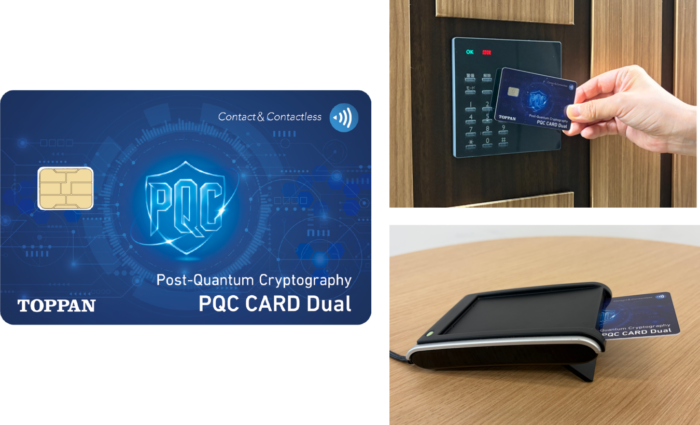
Toppan has developed a dual-interface smart card, PQC CARD Dual, that can be used for both contact and contactless transactions. Featuring post quantum cryptography (PQC), difficult even for quantum computers to crack, this card is the first of its kind in the world. With an eye to adoption for government ID cards and medical authentication cards that require a high level of security, Toppan aims to offer this solution in the areas of public services and medicine from fiscal 2027.

PQC CARD Dual leverages proprietary memory-saving technology to successfully optimize memory capacity for handling PQC’s extensive cryptographic processing. This optimization makes it possible to integrate PQC, which has greater data needs than those of conventional cryptic methods, on dual-interface chips, despite limited capacity. The built-in algorithm is compliant with the long-term safety encryption standards as designated by the US National Institute of Standards and Technology (NIST). Furthermore, by supporting both current cryptography and PQC, this development will allow for a smooth transition to PQC.
Toppan is advancing efforts for the practical application and further sophistication of these authentication technologies geared toward the approaching generation of quantum computing. By doing this Toppan will contribute to the development of safe and secure next-generation authentication infrastructure.

Current encryption of internet services may be vulnerable to decryption by quantum computing in the future, leading to a worldwide urgency to transition to PQC. The introduction of secure authentication technology for smart cards is also a topic up for discussion, but due to the particularly large size of data required for PQC encryption and digital signatures, along with its complex arithmetic processing, it has typically been considered to be difficult to apply this technology to smart cards on account of their limited memory and processing capabilities.
A particularly significant technological barrier was the need to run transmission control features for contact and contactless use at the same time as extensive cryptographic processes required to equip a dual-interface smart card with PQC with limited memory capacity. However, with both the convenience of tap transactions and the reliability of physically inserting a card, the proliferation of dual-interface smart cards for banking, finance, and ID cards is continuing to grow rapidly. It is estimated that the global market will grow 2.6 times from 2025 to 2032, reaching an estimated 10.7 billion USD,2 an indication of growing latent demand.
Against this backdrop, Toppan has developed PQC CARD Dual, the world’s first PQC equipped dual-interface smart card, by leveraging memory-saving technology developed for smart cards, along with knowledge gained through quantum and post-quantum cryptography R&D.
PQC CARD Dual Features
World’s first both contact and contactless smart card featuring PQC: PQC has been successfully applied to dual-interface smart cards that can perform both contact and contactless transactions. The cards feature PQC algorithms (ML-KEM, ML-DSA3) as designated by NIST standards, as well as conventional cryptography (such as RSA and ECC4), meaning that a single card can be used with both types of encryptions. Thanks to this, it will be possible to use existing infrastructure during the transition period from conventional cryptography to PQC, facilitating a smooth changeover to a PQC environment. PQC can also be applied to single-interface contact or contactless smart cards.
High-speed PQC processing possible thanks to proprietary memory-saving technology: Implementation of PQC requires a huge amount of working memory. At the same time, the standard OS used for smart card platforms is known to take up a large amount of memory space. Toppan has managed to succeed in carrying out huge arithmetic processing required by PQC seamlessly and without compressing the memory domain by leveraging memory-saving technology for smart cards developed over many years.
Flexible operational support through implementation on world-standard general-purpose OS: PQC implementation was successful on Java Card, the world standard platform that most existing smart cards use. This means that applications such as payments, staff identification, and access management can continue to be used as-is by simply updating the cryptographic functionality to PQC.
Toppan aims to carry out PoC testing for PQC CARD Dual and related systems within fiscal 2026 for industries requiring a high level of security, such as public services and medicine. Once efficacy has been confirmed, Toppan aims to begin offering PQC CARD Dual and related systems from fiscal 2027 with an eye to the roadmap being followed by countries in Europe along with the US for an extensive transition to PQC in 2030s. Toppan will continue to advance the practical application and sophistication of authentication technologies to ensure the safe distribution, storage, and utilization of highly confidential information well into the future.