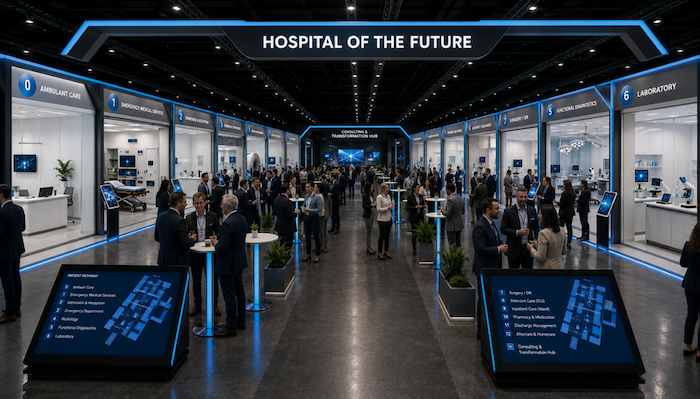
What does a hospital look like where Medical technology, digital infrastructure and clinical processes work together intelligently? The newly designed Medica Hospital of the Future will bring this to life from 16 to 19 November as part of Medica 2026 in Düsseldorf. In Hall 12, a realistic hospital environment is being created in which several manufacturers will jointly present their technologies and solutions at various stations along the clinical ‘patient journey’.

Rather than showcasing their products at their own exhibition stands, they will jointly demonstrate integrated care processes within a curated, holistic clinical scenario – from admission through to diagnostics, the operating theatre and the intensive care unit, right through to further treatment and aftercare. Participants include Asanus, B. Braun, Dräger, Getinge, Philips, OR.NET and United Robotics.
The Hospital of the Future thus exemplifies the strategic development of Medica: innovations are not presented in isolation, but within their specific application context. For hospital management, executive boards, Medical directors, IT managers and other decision-makers, it becomes clear which technical, organisational and infrastructural requirements are necessary to transform individual solutions into integrated care.

The showcase is also at the heart of the new Healthcare Transformation Campus in Hall 12. Carmen Berger, director of Medica & COMPAMED at Messe Düsseldorf, explains, “With the Medica MAIN STAGE, the German Hospital Day, the Hospital Leadership Summit, the Hospital Procurement Summit, the Wearable Technologies Conference Europe and the Wearable Technologies Pavilion, the campus creates a central hub for innovation, exchange, knowledge transfer, collaboration and business.“
Networked care system
Various use cases demonstrate what this approach looks like in practice. Getinge Germany, for example, is showcasing at several stations how its solutions intelligently connect different areas of a hospital.
“At the heart of it all is a digital Hospital Command Centre acting as a central control unit, where information from various departments is consolidated. This creates greater transparency regarding clinical and operational processes, enabling more targeted decision-making and more efficient management of workflows – with the aim of utilising resources as effectively as possible and sustainably improving patient care,” says Katrin Uhmann, Hospital Transformation manager at Getinge.
The key message is that a single, technically advanced application is not sufficient to transform a hospital. Data must be available and able to flow between the relevant stakeholders and systems. Clear responsibilities and structures are also needed to enable the use of new solutions in day-to-day clinical practice.
Connected care
That is why the Hospital of the Future not only showcases digital applications, but also their integration into clinical workflows and existing infrastructures. “We are demonstrating how open, cross-vendor networking improves clinical processes whilst also safeguarding investment in a future-proof IT and Medical technology infrastructure,” explains Marcus Köny, a member of the Executive Board at OR.NET e. V., a manufacturer initiative for open and secure standards for the networking of Medical technology. “Visitors to our ward will experience concrete applications of IEEE 11073 SDC – from digitally connected ambulances, through workflow optimisation in interoperably networked operating theatres and the ‘Silent ICU’, right through to smart sensor technology on general wards,” Köny continues.
This brings a key challenge of hospital transformation into sharp focus: new technologies only realise their full potential when they can be integrated into existing processes and systems communicate reliably with one another.
Telemedicine & networked care
The German Society for Telemedicine (DGTelemed) is one of the project partners of the Medica Hospital of the Future. It contributes its expertise in the cross-site networking of Medical services and, together with partner institutions, demonstrates specific applications – ranging from tele-intensive care medicine and telemonitoring for heart failure and cardiac arrhythmias to telemedicine-supported sleep medicine. This also involves the use of artificial intelligence and the technical, organisational and economic prerequisites for functioning care networks.
Strategy and application
The Hospital of the Future is closely linked to new networking formats for hospital management. The Hospital Leadership Summit (18 November) brings together international hospital management teams to discuss leadership, digitization, investment and the implementation of hospital transformation. The Hospital Procurement Summit (19 November) focuses on strategic procurement, resilient supply chains and long-term, economically sound investment decisions.
Both English-language events will take place in Hall 12 and include exclusive guided tours of the special exhibition. This will enable participants to directly link the strategies discussed with specific technologies and application scenarios.
In addition, a German-language symposium on 17 November, entitled “Where is the German hospital landscape heading?”, will address the implications of hospital reform, the shift towards outpatient care and the economic challenges facing inpatient care.
Today’s solutions
“The Hospital of the Future deliberately does not present a futuristic, high-tech hospital far removed from today’s healthcare practice. The focus is on solutions that are already in use or can be tested in specific care scenarios,” sums up Carmen Berger.
This makes the newly designed program format a particularly visible example of Medica 2026’s commitment to transformation: moving away from the isolated presentation of individual innovations towards the interplay of technology, processes, infrastructure and people within practical care scenarios.
Access to the ‘Hospital of the Future’ showcase is included with a standard exhibition ticket.