How is artificial intelligence changing diagnostics? How can health data be used to deliver more personalized care? And what is needed to ensure that robotics, cloud technologies and extended reality become part of everyday clinical practice? The new Medica Digital Health Stage will bring key issues relating to digital transformation to the fore at Medica 2026 in Düsseldorf, taking place from 16 to 19 November in Hall 17 – with a clear focus on implementation.

The new stage thus exemplifies the strategic development of Medica, as Carmen Berger, Medica´s director at Messe Düsseldorf, emphasizes, “Our aim is not only to showcase digital innovations, but also to demonstrate how they can be effectively integrated into healthcare provision. On the Medica Digital Health Stage, we will bring together academia, healthcare practitioners, start-ups and technology companies with the decision-makers who will put these solutions into practice. In Prof. Dr David Matusiewicz, we have secured the partnership of one of the most renowned experts in the digital transformation of the healthcare sector, both for our new Medica Advisory Board and for shaping the content of the stage.
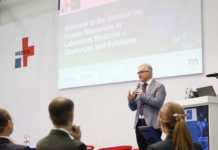
Under the program leadership and moderation of Prof. Dr David Matusiewicz, dean of Health & Social Sciences at FOM University of Economics & Management, the program features keynote speeches, discussions and best-practice examples. “The Digital Health Stage is more than just a venue for presentations. It is a meeting place for those who want to actively drive forward the digitalization of healthcare,” said Matusiewicz.

AI: The key factor is the benefit to patient care
Artificial intelligence is one of the central themes of the Medica Digital Health Stage. Health data and intelligent algorithms are increasingly being incorporated into clinical decision-making processes. Discussions will therefore focus on how AI can support doctors and other healthcare professionals, and what opportunities it opens for diagnostics, treatment and personalized medicine.
This is not solely about technological capability. Trust, transparency, clear lines of responsibility and the protection of sensitive health data are equally crucial. Only when these conditions are met can AI-based systems be sustainably integrated into healthcare processes.
When digital intelligence meets physical technology
Digital health does not end with software. Another key focus is the interplay between digital intelligence and physical technology. Robotics brings digital systems into direct contact with patients and Medical staff – for example, in the operating theatre, in rehabilitation or in nursing care. Cloud technologies enable the processing and exchange of large volumes of data. Extended reality opens new possibilities for training, diagnostics, treatment and surgical procedures.
“AI provides the intelligence, cloud technologies connect systems, robotics translates digital capabilities into action, and XR expands the possibilities for interacting with digital information,” says Matusiewicz, who is also Director of the Institute for Health and Social Affairs (ifgs) at FOM, summarizing the interplay between these technologies. “New forms of Medical care could emerge from this interplay,” adds Matusiewicz.
It is precisely this interplay that the new stage at Medica will focus on: what solutions emerge when technologies are conceived not in isolation but as components of integrated care systems?
Health data must reach the point of care
A key prerequisite for this is the availability and usability of health data. Interoperability, electronic health records and digital platforms are therefore just as much on the agenda as new models of data-driven care. Information must flow securely and, as far as possible, without any disruption between the stakeholders involved. At the same time, digital applications must meet requirements for data protection, technical security and user-friendliness.
Telemedicine, remote monitoring and hybrid care models will also be discussed. They can complement care, particularly in situations where face-to-face support is not always necessary or possible.
Live hacker attack highlights cyber risks
As digitalization and connectivity increase, so too does the attack surface. Cybersecurity is therefore a key focus on the Medica Digital Health Stage. A highlight will be the simulation of a live hacker attack, which will kick off the first day of the exhibition (16 November) at 11 am. Visitors will experience first-hand how digital systems can be attacked and the consequences that security vulnerabilities have for healthcare organizations.
“Cybersecurity must not be viewed as an isolated IT issue. It directly affects patient safety and the functionality of the entire healthcare system,” Matusiewicz emphasizes.
Cybersecurity thus also becomes a prerequisite for digital resilience. A hospital’s infrastructure must not only function during normal operations but also remain stable under exceptional strain.
Prof. Alexandra Jorzig of Jorzig law firm adds a legal perspective to the Medical and economic debates. “Legal and ethical responsibility in digital settings is becoming increasingly important in order to safeguard patients, users and operators,” says Jorzig.
Hall 17 becomes Medica’s Digital Health Hub
The Medica Digital Health Stage brings together diverse perspectives from the digital healthcare ecosystem. Its location in Hall 17 is perfectly suited to this. In the immediate vicinity, the Medica Start-up-UP Park and pitches on the adjacent Medica Start-up Stage showcase around a hundred start-ups presenting their latest innovations for digitally driven healthcare.
This is where the start-up scene and technology pioneers meet potential partners from healthcare, industry, research and investment. At the same time, the stage programme is aimed at an audience of decision-makers who need to select, evaluate and implement digital solutions. The focus is on specific questions: Does a solution fit in with existing processes? How can it be integrated? What benefits does it bring for patients and Medical staff?
Hall 17 will thus become Medica’s Digital Health Hub – a meeting place for innovations, applications and all stakeholders keen to drive forward the digital transformation of healthcare.
Technology only becomes relevant through application
The new Medica Digital Health Stage thus embodies a central theme of Medica 2026: technological innovation alone does not yet transform healthcare. What matters is whether and how it finds its way into everyday clinical practice and creates tangible added value there.
Keynote speaker Prof. Dr Jochen A. Werner, former CEO and Medical Director of Essen University Hospital and also a member of the Medica Advisory Board, sums up this aspiration: “The hospital of the future is being created right now: with AI, robotics and technology that make medicine better and more humane.”
Access to the sessions on the Medica Digital Health Stage is included with a standard exhibition ticket. Full details of Medica 2026 (16–19 November) are available online at https://www.Medica-tradefair.com.